
A X E L D O Y E L S T U D I O
Polymita Picta: History, Philosophy and Digital Art Collection

A Collection for a Lifetime
Axel Doyel Studio presents its main collection, the only one that will feature special editions every year. In this way, it offers the opportunity to own a living NFT collection in constant motion, just as its spiral of shapes and colors is infinite.
Let's Make NFTs Last Forever
Start following my work, and you will see that you will always have access to the latest and most exclusive editions of Polymita Picta, year after year, in addition to all my other works.
I am a prolific artist who maintains a consistent thematic line throughout his work. The tool does not matter: the essence remains the same.
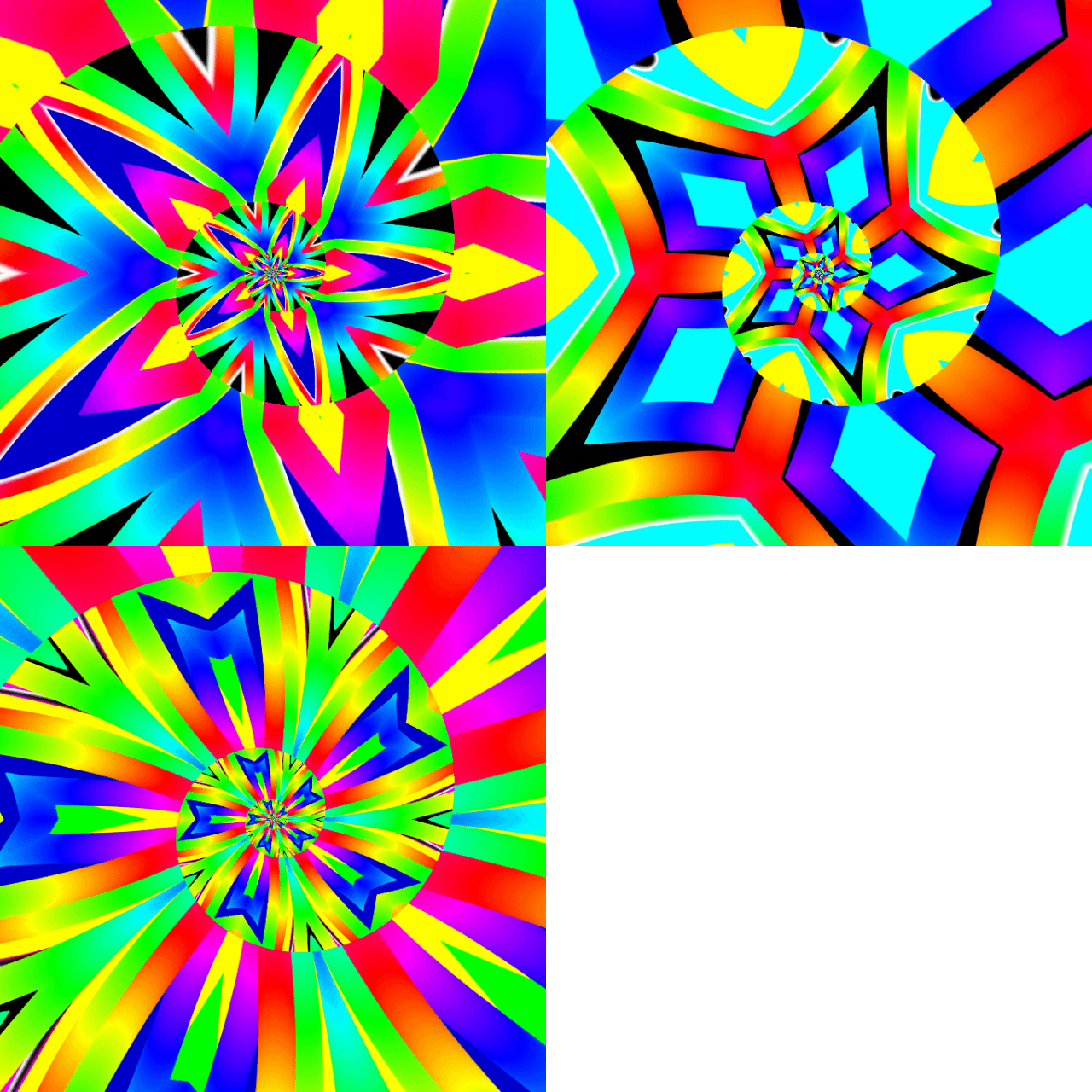
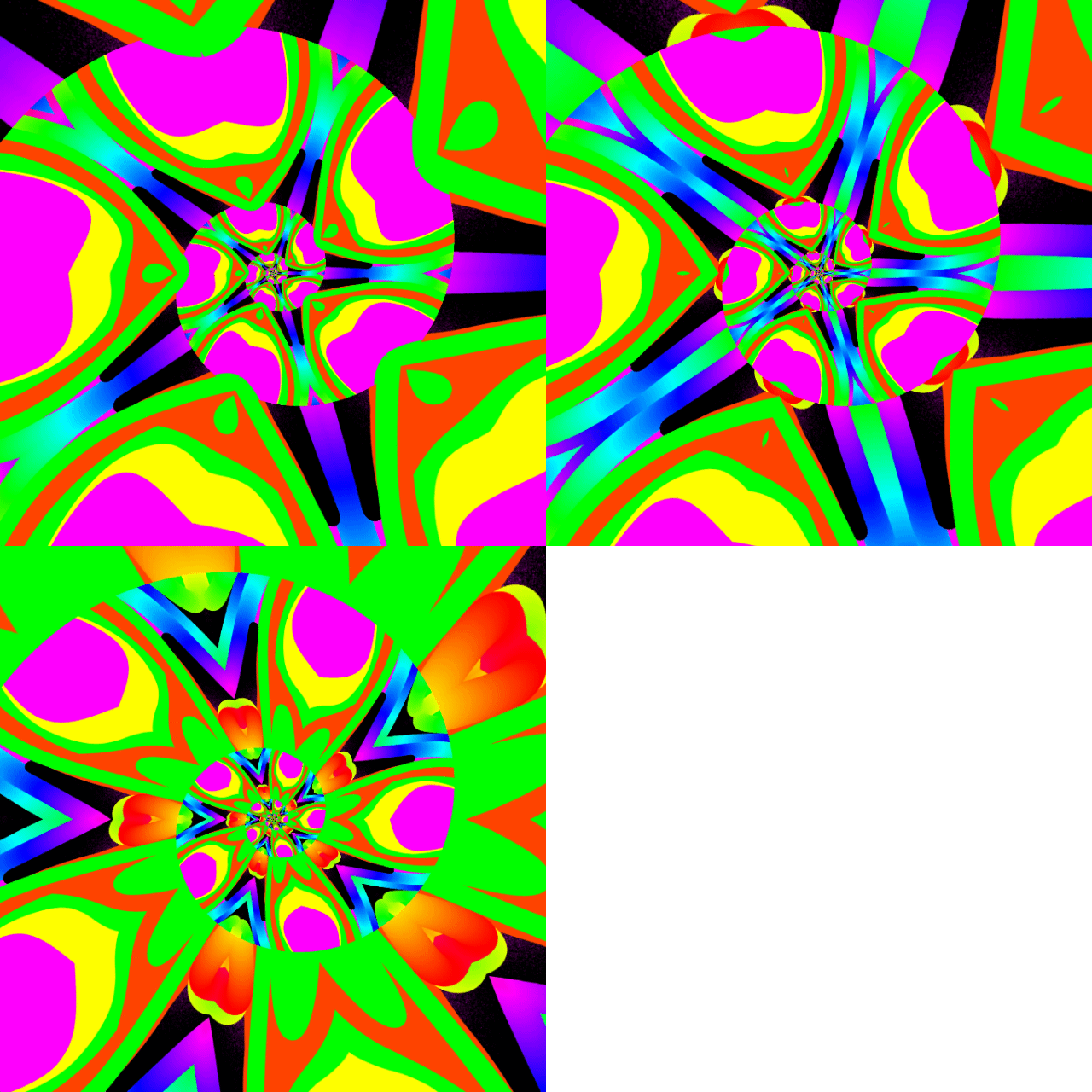
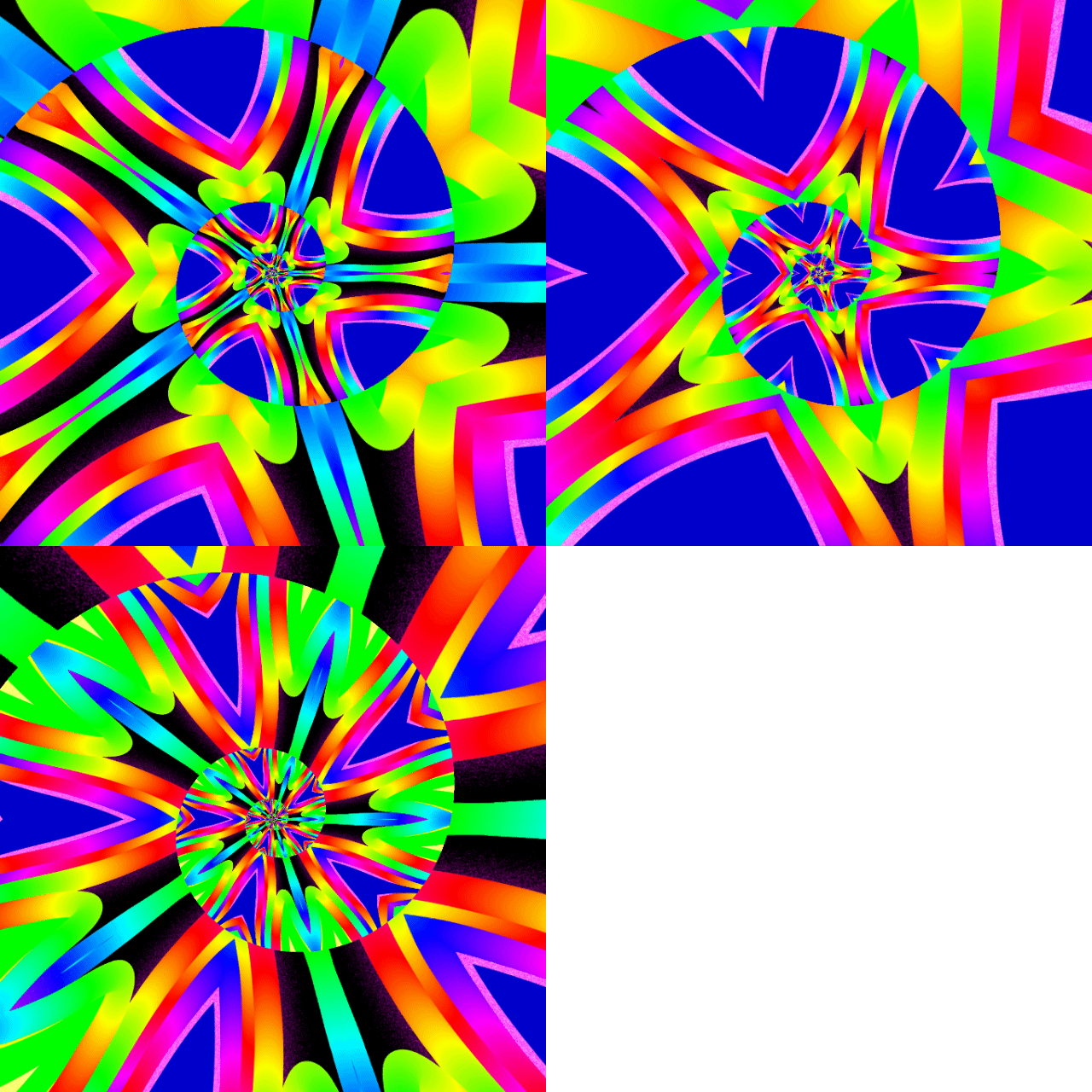
Polymita Picta is an NFT collection in the form of GIFs and photographs, inspired by snails and their infinite spiral. The NFTs aim to be as infinite as the snails' own spiral. They were born before us and formed in the depths, long before the Internet era.
These snails inhabit more than two hundred different plant species, whether on their leaves or at the base of their roots and branches, often hidden from our sight. However, they now make their grand debut, offering us an infinite universe of shapes and colors through the fascinating Web3.
This collection consists of two parts. The first part of this major collection of GIFs and photographs is created in black and white. It recalls elements of their natural habitat and the beginnings of their formation, paying tribute to the way these snails emerged many years ago.
In the same way, it pays tribute to the beginnings of digital and audiovisual media, when everything was likewise in black and white, and to how their convergence ultimately gave rise to what we know today as computing and the Internet.
Undoubtedly, the 19th century was a crucial era in human history, marked by decisive advancements toward the creation of everything we recognize today as digital media.
The threads of this story date back to the year 1800, when Joseph Marie Jacquard, a French weaver and merchant, created the first programmable loom using punch cards with figures and designs.
Shortly after, women played an important role in this story. The brilliant British mathematician and writer Augusta Ada Byron King, daughter of the poet Lord Byron and better known as Ada Lovelace, became the mother of programming by writing the first computer algorithm in history.
In the same century, the first advances in photography and cinema took place. In 1827, the French inventor Joseph Nicéphore Niépce captured the first photograph, titled View from the Window at Le Gras.
Sixty-one years later, another French inventor, Louis Le Prince, filmed one of the first sequences of moving images, known as Roundhay Garden Scene. In doing so, he anticipated Thomas Edison and the Lumière brothers.
For this reason, we can state that the Lumière brothers were not truly the fathers of cinema. If you have read carefully, you will have noticed that Louis Le Prince was one of its principal pioneers.
The second and most extensive part of the collection delves into the extraordinary transformation of snails into countless shapes and colors, the very elements that surround us in our daily lives. One could say that everything is part of a constant ebb and flow of shapes and colors, much like the infinite spiral of snails.
This part of the collection also emphasizes speed. Some snails move slowly, reminiscent of the history of the development of the computer, the smartphone, smart TV, cameras, and other digital media. As you may have observed, these technologies did not emerge overnight.
Much like the slow pace of snails, their development was a gradual process of interpreting and understanding the medium, until transforming it into a product capable of satisfying our needs.
However, there are also much faster snails. This time, they have entered the territory of the Internet and move at the very speed at which its signal reaches us.
Undoubtedly, they traverse the digital highway of NFTs and their marketplaces, allowing non-fungible tokens to connect us within an infinite spiral in which you and I are participants.
I have just told you about the essence of my first NFT collection. Now, if you keep reading, I will share with you the fascinating history behind these snails


A Small Creature with a Gigantic Legacy
Today I bring you the incredible story of a small creature with a gigantic legacy. Its existence has been intertwined with the works of great painters, poets, and collectors, and has even captured the attention of royalty. In 2022, it also received significant recognition as the most beautiful snail in the world.
Its name originates from Greek culture; however, it chose the Caribbean as its habitat, on the other side of the world.
You might not believe it, but I am talking about a snail: one of nature's smallest creatures, yet endowed with a beauty capable of justifying every word you are reading and the countless days and nights I dedicated to creating this collection.
Each NFT in this collection was meticulously crafted by hand. As a result, the pieces created are completely unique: there are no two identical NFTs in the collection. Each one features a special and distinctive design that brings added value.
Axel Doyel Studio is pleased to present its first major Polymita Picta NFT collection, composed of two thousand pieces in the form of GIFs and photographs.
This collection is inspired by the Polymita picta snail, also known as the painted snail, whose shell exhibits an extraordinary variety of colors and hues.
In 2022, it was recognized as the most beautiful snail in the world after obtaining more than ten thousand votes in a competition organized by the LOEWE Centre for Translational Biodiversity Genomics in Germany and the Worldwide Society for Mollusc Research.
This snail lives exclusively in the eastern region of Cuba and reproduces during the rainy season through a complex mating ritual. Its existence is unjustly ephemeral, as it usually lives for only one to two years. Polymita picta is a land snail endemic to Cuba, renowned for the diversity of colors on its shell, which has captivated countless people since well before the 20th century.
These snails not only impressed nature enthusiasts, but also found a place within the works of painters and poets. Dutch painters Johannes Bosschaert and Balthasar van der Ast chose these snails as significant elements in their still lifes.
Likewise, Chilean poet Pablo Neruda, an enthusiast of malacology—the science that studies mollusks—, mentions these snails in the third poem of Lámpara en la tierra, belonging to his work Canto general. From that poem, I share this brief excerpt:
“The man of the islands went about weaving bouquets and garlands of sulfur polymita...”
Beautiful, isn't it? Undoubtedly, nature, science, and the arts are inseparable.
Cuba holds enormous significance for global biodiversity due to its unique geomorphological history, its high relative humidity, its high tropical temperatures—exceeding thirty degrees—, and the widespread presence of limestone across the island's geography.
These conditions create an ideal environment for the development of land snails. For this reason, they captured the interest of numerous European and Cuban naturalists starting in the 19th century and, later, American malacologists during the 20th century.
The most prized snails, as you may have guessed, belong to the genus Polymita, whose name has Greek origins and means “many stripes”.
It is incredible that such a tiny creature, with a maximum width of approximately three centimeters, is connected to different parts of the world and history, in a way similar to how the Internet connects us all.
One of the most striking aspects of this species, and what served as inspiration for the collection, is its color polymorphism, considered one of the most remarkable in the animal kingdom.
These snails also play an important role in eliminating fungi found on plants such as coffee and guava. This highlights the close connection that exists between human beings and nature.
As we approach the end of this narrative, let me tell you who scientifically described this species and why I mentioned at the beginning that its history was also linked to royalty.
The species Polymita picta was described in the 18th century by the Austrian mineralogist Ignaz von Born, who lived between 1742 and 1791.
At that time, the nobility used to dedicate part of their time to gathering extraordinary pieces of natural history. These collections were known as cabinets of curiosities.
Emperor Francis I was the first to create what would become one of Austria's principal private collections of natural history. This included minerals, fossils, snail shells, mussels, and corals.
After his death, the collection passed into the hands of the State. In 1776, his wife, Maria Theresa of Austria, entrusted Baron Ignaz von Born with the task of organizing and expanding it. Two years later, in 1778, von Born scientifically described the first Polymita picta.
As if the history of these snails were not intriguing enough, it was also surrounded by deception and falsehoods. The first specimens of this species added to certain collections were falsely recorded as originating from Italy, when in reality they came from Cuba.
This false information was used to jealously guard the exclusivity of the collections, even when it meant concealing the true origin of the pieces.
Digital Art and NFTs Collection: Polymita Picta
Leonardo Fibonacci and the Golden Ratio

"Analytical diagram of the Fibonacci sequence and the geometric construction of the golden spiral. Mathematical foundation and compositional grid of Axel Doyel Studio."

"Biological manifestation of the golden ratio in the morphology of a natural shell. The organic link between sacred geometry and the work of Axel Doyel Studio."
Last but not least, I dedicate this section to Leonardo Fibonacci and the golden ratio. Leonardo Fibonacci, who lived approximately between 1170 and 1250, was an Italian mathematician considered one of the most important of the Middle Ages. He was born in Pisa, Italy. His real name was Leonardo of Pisa, although he became known as Fibonacci, a name meaning “son of Bonacci”.
Notable Contributions of Fibonacci
-
He contributed to spreading the Hindu-Arabic numeral system in Europe.
-
He presented the mathematical problem that gave rise to the well-known Fibonacci sequence: 1, 1, 2, 3, 5, 8, 13, 21...
-
He developed and solved various problems related to arithmetic, algebra, and geometry.
-
He wrote influential mathematical works, such as Liber Abaci, published in 1202, and Liber Quadratorum, published in 1225.
The Golden Ratio
The golden ratio, also known as the golden mean, golden number, or phi (φ), is a mathematical constant whose approximate value is:
φ = 1.61803398875...
It is obtained through the following formula:
φ = (1 + √5) ÷ 2
The golden ratio appears when a line is divided into two segments such that the ratio of the total length to the longer segment is equal to the ratio of the longer segment to the shorter one.
Key Features
-
Relationship between lengths: represents a particular mathematical proportion between two segments.
-
Irrational number: it cannot be expressed exactly as a fraction of two integers and possesses an infinite number of non-repeating decimals.
-
Geometry: it can be observed in geometric constructions such as the golden rectangle, the regular pentagon, and the golden spiral.
-
Art and design: numerous artists, architects, and designers have used or studied this proportion in their compositions.
-
Nature: some growth and distribution patterns found in plants can approximate relationships related to the Fibonacci sequence and the golden ratio.
The relationship between Fibonacci and the golden ratio
-
The Fibonacci sequence is closely related to the golden ratio. By dividing a number in the sequence by the previous number, the result progressively approaches the value of φ.
-
For example:
-
8 ÷ 5 = 1.6
-
13 ÷ 8 = 1.625
-
21 ÷ 13 = 1.615...
-
34 ÷ 21 = 1.619...
-
As we advance in the sequence, the result gets closer and closer to 1.618..., the approximate value of the golden ratio.
The golden ratio in the arts
-
La proporción áurea ha sido estudiada y utilizada como recurso compositivo en diferentes disciplinas artísticas:
-
Arquitectura.
-
Pintura.
-
Escultura.
-
Diseño gráfico.
-
Fotografía.
-
Cine.
-
Diseño de interiores.
-
Moda.
-
En las artes visuales puede servir como guía para distribuir los elementos de una composición, establecer relaciones entre sus dimensiones o dirigir la mirada del espectador.
-
La relación entre la espiral, la sucesión de Fibonacci y la proporción áurea conecta simbólicamente con la colección Polymita Picta. Las formas de los caracoles inspiran una reflexión sobre el crecimiento, el movimiento, la belleza y la continuidad presentes tanto en la naturaleza como en la creación artística.
-
The golden ratio has been studied and used as a compositional tool across different artistic disciplines:
-
Architecture.
-
Painting.
-
Sculpture.
-
Graphic design.
-
Photography.
-
Cinema.
-
Interior design.
-
Fashion.
-
In the visual arts, it can serve as a guide to distribute the elements of a composition, establish relationships between their dimensions, or direct the viewer's gaze.
-
The relationship between the spiral, the Fibonacci sequence, and the golden ratio connects symbolically with the Polymita Picta collection. Snail shapes inspire a reflection on the growth, movement, beauty, and continuity present both in nature and in artistic creation.
ENGRAVING OF LEONARDO FIBONACCI

His research on numerical sequences constitutes the historical foundation of the studio's compositional geometry