
A X E L D O Y E L S T U D I O

Digital
essay


Digital texture: a new visuality; the machine
also has a soul
Digital Essay stems from the experience I acquired creating digital artworks with initially very basic tools. These gradually revealed to me a universe of textures unique to each application used in the creation of my earliest works.
The artworks emerged with a visuality distinct from what was appearing across various online channels showcasing the best of digital art. Those were images celebrated for their refined textures, seamless gradients, and vibrant colors, hyperrealistically rendering all the materials proposed in each piece.
However, as I delved deeper into the digital tools with which I produced my early works, I realized that each of those textures was unlike anything my eyes were accustomed to seeing.
At first, it was a challenging process. Because they were not the same, their quality superficially appeared uneven or inferior. In a sense, it was the machine speaking.
I was not attempting to depict any specific material or texture recognizable to our eyes, nor was I relying on the textures generated by default brushes offered by programs such as Photoshop, among others.
They were unconventional technical solutions that quickly captured my attention in a singular way. I was also drawn to how each of them could be measured and appreciated centimeter by centimeter, as if it were possible to extract more than one visual proposition from the very same NFT.
The color planes—in some cases formed by islands that construct the different chromatic areas and volumes—became one of the most prominent features. It was also intriguing to observe how they overlapped and managed to produce, much like pencil drawing techniques, an optical illusion of color, texture, volume, light, and shadow.
As can be seen in each of the shared images, one can appreciate a very particular way of understanding form and color.
This is just as compelling as the brushstrokes of Expressionism and Impressionism once were, as well as those of other avant-garde movements distant from academic rigor.
Similarly, digital art offers resources equivalent to what the academy represented within painting. Yet it also opens up a freer universe, allowing the artist to explore other avenues capable of notably enriching their work.
In this way, I allow the machine to leave its imprint without the intervention of the artist’s hand seeking to over-correct the image and each of its elements.
I appreciate art that allows the trace of the material used to be seen, and how the machine reveals its own way of understanding color, form, light, and shadow across every square millimeter.
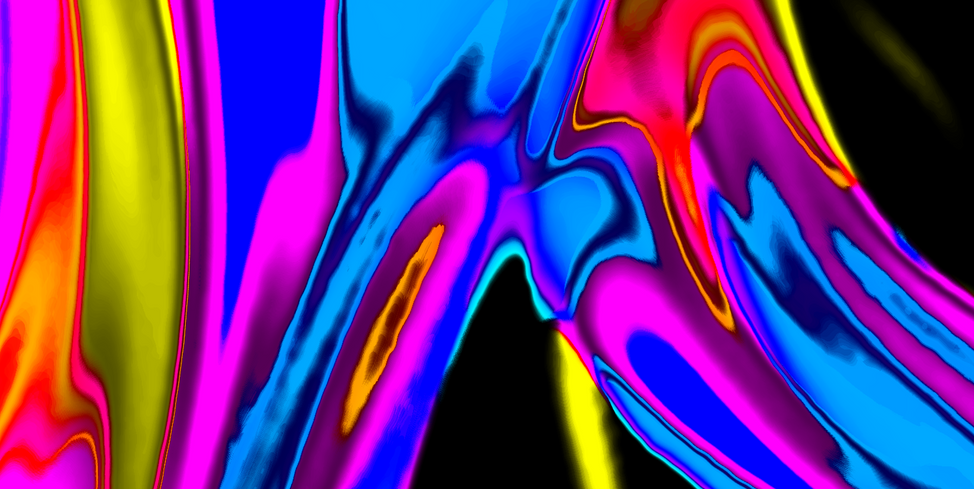


As can be seen across each of the shared images, it is possible to appreciate a very particular way of understanding form and color. This proves just as compelling as the brushstrokes of Expressionism or Impressionism were in their time, as well as those of other more avant-garde styles distant from academic rigor.
Similarly, digital art offers resources equivalent to what the academy represented in painting, yet at the same time provides a freer universe, allowing the artist to explore other avenues capable of notably enriching their work. In doing so, it allows the machine to leave its imprint without the intervention of the artist’s hand seeking to over-correct the image and each of its elements.
I appreciate art that reveals the trace of the material used, and how the machine discloses its way of understanding color, form, light, and shadow across every square millimeter.
Artificial intelligence and
visual arts
Have you ever wondered what impact artificial intelligence has had on art? If you have read this far, you can probably guess what I mean.
Artificial intelligence is, without a doubt, a tool that has marked a decisive turning point in artistic creation, as well as across other fields of human knowledge.
Processing data has now become far easier, considerably reducing the time needed to optimize systems across all areas of life. This allows them to be harnessed for greater performance and, with it, better results.
But what have we truly achieved in the arts?
With the advent of NFTs and artificial intelligence, we have witnessed countless works showcasing the finest software designed for artistic creation. In some of them, we observe subjects displaying hyperrealistic textures that accurately recreate the appearance of objects we know and use in our daily lives.
Their equivalent within art history could be found in the Renaissance or the Baroque, movements in which key figures conceived works with a highly refined technique.
This represented a major breakthrough in contrast to earlier periods of art history, such as Byzantine art or, much earlier during the beginnings of artistic creation, cave paintings.
Centuries later, however, artistic creation began to place greater value and emphasis on experimentation with materials.
Mimesis was relegated to the background within the poetics of many artists. Technique ceased to be—and remains far from being—a fundamental element or a benchmark for measuring the creator's talent.
The idea gained ground over technique. It was then that artists and movements emerged that forged new paths within more traditional forms of art.
Numerous examples exist, such as the works of Jean-Michel Basquiat, Joseph Beuys, Marcel Duchamp, Robert Rauschenberg, and Jackson Pollock, among others.
In contrast, with the arrival of digital art we observe a completely different perspective: the pursuit of an excessive hyperrealism, underpinned by the history of video games—one of the earliest antecedents to the digital boom we are experiencing today.
It is also tied to the ever-increasing advancements delivered by graphics cards from companies like NVIDIA and AMD, among others, and their capacity to refine every aspect of the image.
It is as though digital art and NFTs were living through what Hyperrealism represented for traditional art in a more recent stage of its history.
Digital art and NFTs constitute, in many cases, a mimetic view of reality that showcases its formal qualities. Meanwhile, traditional art turns its gaze toward the deepest passages of our existence.
The latter attempts to decipher or reveal the countless complexities of the human species and the ways in which it transforms its environment. In turn, the environment reshapes humanity—both to its benefit and to the detriment of its present life and future development—thus yielding an unequivocal outcome of our actions.
Which art is more apt: digital or traditional?
Through which do you see yourself reflected?
If you have made it this far, perhaps you share the same questions I do, or even more. In any case, this represents great fortune and a privilege for the creative and inquiring mind.
It also serves as a compelling starting point to continually ask ourselves questions as daring as the one that titles this final section of my first essay.
This text does not claim to be conclusive, much less to pass judgment. These are reflections born from the mind’s freest thought during the creative process: perhaps unfinished ideas, the fruit of an infinite creative exploration.
Today I dare to bring them to light, allowing others to glimpse my way of understanding these new artistic practices, if the term applies.
I have always felt an uneasy sensation whenever I hear the same go-to platitude used to assign a place to something new—something before which some feel threatened:
“Digital art is just another tool.”
It certainly is, and it would be absurd to deny it or consider it a threat.
In the past, Fauvism was a disproportionate response to the fear that the emergence of photography instilled in the painters of the era.
Suddenly, capturing reality exactly as it was became possible, at least from a formal perspective. Yet reproducing the true color of the subject or the sitter remained unresolved. Moreover, only a privileged few could aspire to have their portrait made.
Those portraits could not compete with the scale of pictorial works, which commanded presence by occupying the expansive walls of bourgeois homes. At that time, members of the bourgeoisie were the only ones who could possess canvases created by the most renowned artists.
There were many factors that artists of the period failed to consider when they perceived photography as a threat to their sole means of livelihood.
It is as though the threat triggered fear, and fear catalyzed creation, while everyone defended their ground.
Either way, that process left us with extraordinary works and a new way of representing reality.
The advent of photography brought with it the documentation of reality. For the first time, we succeeded in framing it just as our eyes perceived it.
At the same time, artists sharpened their gaze even further, looking closely at the hidden soul beneath the surface of the environment surrounding them. In doing so, they rendered the representation of reality more abstract in an effort to translate it.
This was a pivotal milestone in art history that we can witness once again within today's contemporary scene through digital art.
Today, digital art can indeed capture reality in full color, across all scales and formats. A 4K resolution seems capable of capturing the entire world in a single second.
Photography, supported by and resulting from technological devices, advanced alongside global progress in every sphere. Concurrently, it mirrored the inequities of that development, exposing how a fortunate few have access to the finest achievements created by and for humanity, while for the vast majority, reality is entirely different.
In this manner, various photographers documented the widespread struggles that so many endure. Such is the case with Andrés Serrano and Ana Mendieta: two distinct approaches that captured the pain of human existence through their lenses, in a far more intimate and personal way in the case of Ana Mendieta.
They represent two ways of seeing and feeling: on one hand, a male photographer; on the other, a woman who used photography to record her performances in an attempt to document the grief she felt.
Yet that grief was also forgotten, its weight fading perhaps even faster than the duration of her performances themselves.
Photography became an act of protest and a mirror of her soul, leaving behind images of what her inner being revealed to us, transformed into art.
They were two artists who forgot that photography was made with a camera and reached deep into the visceral core to render the truth they felt they owed us—much like Cézanne immortalized when he declared he was leaving us the truth transformed into painting.
Neither Andrés Serrano nor Ana Mendieta was seduced by the mere capability of their cameras to record reality with extraordinary realism. They went far beyond, discovering the complexity and richness of light and color to bring us closer to what their souls managed to perceive.
One need only look at their works to understand that they did not flaunt the pixels of their cameras to deliver images that, by virtue of technical polish, resembled travel brochure photography, to use an illustrative comparison.
Instead, they intervened in every nuance of the image to offer us their soul.
And this is where I arrive at the crux of this essay. I understand that this is the essential element we must consider within the new journey of digital art and all its manifestations, including NFTs.
As artists and human beings, we must find in this new artistic practice a way to engage with the manifold challenges we face.
We must ask ourselves where we come from, but above all—and this is what is most pressing—what we are doing to ourselves, where this is leading us, and where it will carry future generations.
Digital art and NFTs carry immense significance within their current and future landscape. Both are products of the most inventive facet of the human species and our remarkable capacity to reshape our environment almost magically, provided we hold that purpose as one of the central objectives of our existence.
Technologies, particularly those rooted in computing, are “the eighth wonder of the world.” The number eight carries an inherent association with fortune.
Certainly, technological advancement is responsible for enabling the inhabitants of this planet to enjoy greater fortune and enhance their lives.
I see in the rise of digital art and NFTs, as well as their integration into the arts, the most fitting expression of human intelligence.
This is one of the most critical moments to express ourselves through art. We have the opportunity to reflect within our works not only our shadows, but also our light.
We must constantly bear in mind that we are the only inhabitants of Earth endowed with thought abstract enough to understand and transform the world, as well as to construct a surreal digital realm running parallel to nature.
For centuries, from its origins and throughout its development, art addressed everyday themes, such as the visual representation of biblical passages and their impact on the faith of believers and non-believers alike.
Today, however, the arts and emerging currents—such as the digital realm—grant artists an extraordinary power to offer a far more comprehensive and impactful poetics.
I believe this is a opportune moment to open up dialogue and debate without reservation. For centuries, we have established shifting criteria about what we deem correct or incorrect.
Thanks to the great masters of art history, many notions that stood in the way of freer, more spontaneous creation were gradually put into perspective.
An example is the master Wifredo Lam, whose work I was able to contemplate at the Museum of Cuban Art. There, I noticed how Lam did not erase the graphite lines with which he structured his compositions. Some of those lines were drawn using a ruler, deliberately straying from the classical dogma regarding the artist’s freehand gesture.
Those lines spoke; they revealed the earliest steps of the work’s genesis, bearing witness to its before and after.
This idea, embraced by numerous visual artists, also transcended into architecture. An example is the Centre Pompidou, designed by Renzo Piano, one of the most significant figures in modern architecture, who skillfully inverted structure to bring into the light elements that had previously remained hidden in the shadows.
New technologies offer an extraordinary toolkit capable of providing us with abundant expressive avenues. Without question, these will grant the arts a more visible presence in people’s daily lives, far beyond the gallery walls.
Powerful software and screens, both large and small—from the devices we hold in our hands to the massive displays broadcasting across global cities—possess the ability to disseminate the work of creators within seconds.
I believe this is the dimension that artists of our time must seize most effectively. In doing so, we can maximize the potential of new technologies and their relevance within today's artistic landscape.
We can also employ these media to reach newer generations and offer them an equally humanist vision.